A pickup runs late. The delivery appointment stays fixed, and the same equipment is booked for another shipment the next morning. The dispatcher has to keep track of all three commitments while answering questions from drivers and brokers.
Finding freight is only part of a dispatcher’s responsibilities. The job also involves schedules, records, software, and regulatory limits. Effective truck dispatchers stay organized when several people need answers at once.
A truck dispatcher training course brings these responsibilities together in a structured setting. For someone researching how to become a truck dispatcher, it offers a way to get familiar with freight terminology and daily workflows before taking on active shipments. It also gives applicants a clearer picture of what truck dispatcher jobs involve and how the role fits within the broader logistics industry.
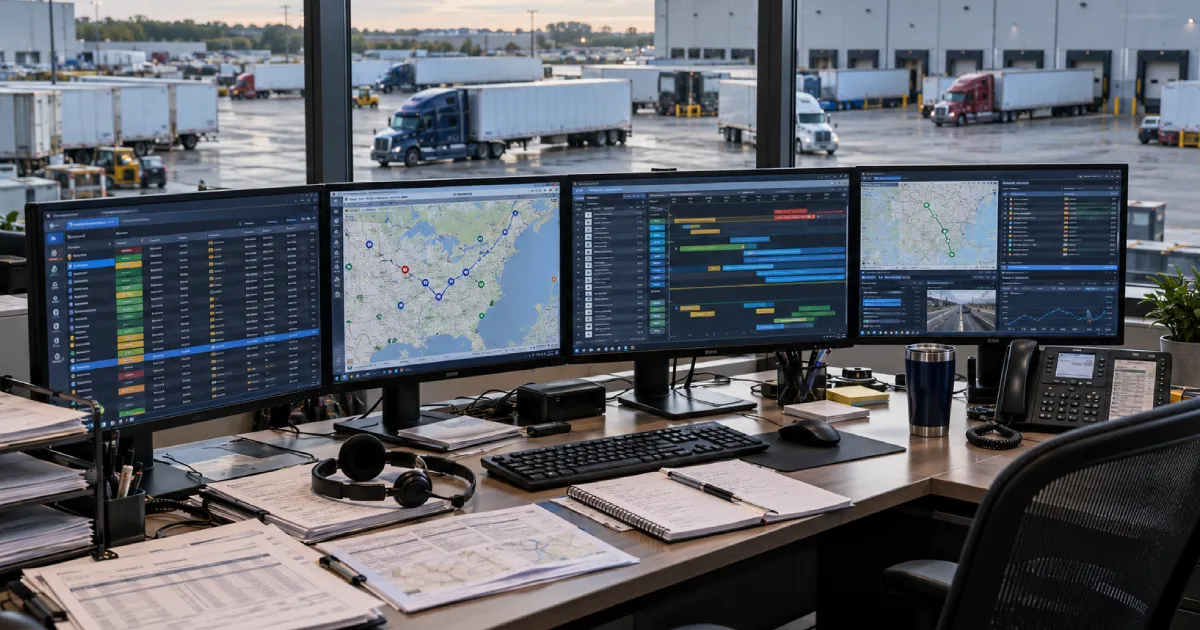
A dispatcher coordinates freight movements for a carrier, the company transporting the goods. The work includes:
Load boards list freight opportunities. A listing is only the beginning of the assignment, though. Load planning also involves the equipment’s existing commitments and the conditions attached to the shipment.
In this scenario, broker communication means following up on the estimated loading time. Route planning and shipment tracking now revolve around the delay. The truck is at the correct location, but nothing is moving.
Managing these overlapping demands is a major part of a truck dispatcher’s job. A phone call may end before the underlying issue is resolved. Someone must follow up and leave enough information for a colleague taking over later. Organizational skills are especially important during those handoffs, including documenting confirmed details separately from unresolved questions.
Hours of Service (HOS) rules set limits on driving time and account for on-duty work. Driver availability therefore depends on more than an empty vehicle. Time spent waiting must also be considered when planning the schedule.
Participants work with freight listings, shipment records, transportation documents, and changing delivery requirements during practical logistics exercises. Each assignment requires them to evaluate new information and revise their decisions accordingly.
An available truck is not automatically suitable for every listed load. Participants compare equipment type, shipment requirements, pickup and delivery times, driver availability, and existing commitments before selecting freight.
At 12:15 p.m., the warehouse still says the freight will be ready “soon,” while the receiver refuses to move the delivery appointment. Participants must decide which details are confirmed, what information remains missing, and how to update the driver and broker without presenting an estimate as a firm commitment.
The same exercise introduces the commercial side of dispatching. Participants examine how delays, additional waiting time, requested services, route conditions, and current market rates affect negotiations with freight brokers. The instructor may pause the role-play when the warehouse representative says “soon” and ask what evidence supports that estimate.
Shipment tracking covers the vehicle’s location, load status, appointment times, and reported delays. Route planning accounts for distance, road conditions, delivery requirements, Hours of Service limits, and the equipment’s next commitment. Participants learn how one schedule change can affect several connected shipments.
Dispatch software provides an accurate record for the next person handling the shipment. Common dispatch paperwork includes:
For U.S. operations, the curriculum covers Federal Motor Carrier Safety Administration (FMCSA) rules, including Hours of Service (HOS) requirements. Cross-border instruction also explains the differences between U.S. and Canadian regulations and which rules apply in each country.
Knowing what a rate confirmation contains is a start. It does not explain how to handle conflicting information when a delivery appointment is approaching. A truck dispatcher training course gives participants time to work through that uncertainty with an instructor.
During a classroom exercise, a student might record an estimated loading time as confirmed. The instructor reviews the entry, identifies the unsupported assumption, and explains how inaccurate wording affects driver, broker, and customer expectations.
Students use logistics software, sample documents, and real-world dispatch scenarios to record updates, explain their decisions, and revise their work based on instructor feedback. This process develops both operational judgment and precise communication.
Our live online and classroom programs include instructor interaction, access to logistics software, and feedback during exercises. We keep class sizes small and provide individual guidance along with mentorship and support after training.
Before enrolling, candidates should confirm which software the course uses and how instructors evaluate student work. They should also confirm whether feedback is provided individually or through group reviews of selected exercises.
Some people learn dispatching by working alongside an experienced colleague at a trucking company. Others take a course first, then build experience on the job.
| Structured training | Learning on the job |
|---|---|
| Concepts introduced in sequence | Learning follows active freight situations |
| Guided software use | Systems are learned through assigned tasks |
| Instructor-led scenarios | Experience gained from live shipments |
| Compliance concepts introduced early | Requirements are explained as duties arise |
| Dedicated time for feedback | Supervisors review work as it happens |
That does not mean workplace learning is necessarily less structured. A supervisor who explains decisions and reviews early work provides valuable guidance. The harder situation is joining a busy office where nobody has time to answer questions.
Finishing a course does not guarantee employment or readiness to manage freight independently. Supervised work remains important afterward, especially when someone encounters unfamiliar systems, equipment, or customer requirements for the first time.
Employers across the transportation industry typically look for truck dispatchers with communication, scheduling, recordkeeping, and problem-solving skills, along with familiarity with dispatch software. A training course introduces these areas, but candidates still develop practical judgment through supervised work.
People enter dispatching from the trucking industry, transportation administration, freight brokerage, customer service, and other logistics roles. Some plan to start their own business. Someone used to handling customer calls may feel comfortable on the phone but have little experience scheduling freight. A driver moving into an office-based role brings practical knowledge of life on the road, though dispatch software may be unfamiliar.
Applicants can prepare a concrete example for an interview, such as a time they resolved a scheduling problem or clarified an unclear request. The example shows how they handled uncertainty. After hiring, company procedures and supervised work help them apply what they learned to the employer’s operation.
A dispatcher helps a carrier coordinate its shipments. In the U.S., freight brokers arrange transportation between shippers and authorized motor carriers and must meet separate regulatory requirements. Someone planning to start a dispatch business must first define which services the company will provide and understand where dispatching ends and regulated freight brokerage begins.
A well-structured truck dispatcher training course provides a detailed curriculum and explains how each lesson combines theory, software practice, and realistic dispatch scenarios. Sample exercises also show how participants apply several skills within a single freight assignment.
Core topics to look for:
Candidates should also confirm what the fee includes, whether software or materials cost extra, and what attendance and technical requirements apply. For post-training support, they can ask how questions are submitted and how long support remains available. Applicants balancing classes with a job also need to know how much work to expect between sessions.
Entry requirements and the level of industry knowledge assumed also affect whether a training course suits a particular candidate. Programs combining dispatcher and freight broker training should specify how much instructional time is devoted to dispatching, brokerage, software, and business operations.
Our Truck Dispatcher and Freight Broker Specialist program brings together dispatching, brokerage, software, documentation, load selection, and business topics. We offer live online and classroom options for newcomers and experienced transportation staff.
Before choosing a class, applicants should obtain written information about the curriculum, software access and course materials, and included support. These details make it easier to compare programs on the same terms and determine whether the schedule and workload are manageable.
Our team at MAZE Consultancy & Training provides detailed information about the combined program, class format, and enrollment process. Contact us to discuss your background and career goals, understand what participation involves, and confirm everything included in the program.

Dispatch training covers load planning, rate negotiation, route coordination, shipment tracking, transportation documents, and compliance requirements. It also introduces truck dispatch software and realistic freight scenarios. Students practice responding to delays, recording updates, and separating confirmed information from estimates. These exercises reflect core truck dispatcher responsibilities and help develop communication skills for working with drivers, brokers, carriers, and customers. The goal is to help students understand daily workflows before handling active freight.
The best truck dispatcher training courses combine industry knowledge with practical exercises, software access, instructor feedback, and realistic documents. A credible truck dispatch training provider explains the curriculum, class format, entry requirements, additional costs, and post-course support before enrollment. The training program should also specify how much time is devoted to load planning, brokerage, compliance, documentation, and business operations. Small classes and individual feedback are particularly valuable when students work through complex scheduling decisions.
Experience as a truck driver provides valuable knowledge of routes, delivery appointments, waiting time, equipment, and Hours of Service limits. Drivers often understand how dispatch decisions affect work on the road. However, moving into an office role also requires familiarity with software, load boards, transportation documents, rate negotiation, and customer communication. A dispatcher course helps connect existing driving experience with the administrative and commercial side of coordinating freight. Additional supervised practice remains important after training.
A practical dispatch training program requires students to make decisions rather than simply memorize definitions. Exercises should involve freight listings, equipment requirements, appointment times, route conditions, driver availability, and incomplete warehouse updates. Students also work with sample rate confirmations, bills of lading, and proof-of-delivery records. Instructor feedback is essential because effective dispatch operations depend on accurate documentation, sound judgment, and precise communication when one change affects several shipments or commitments.
Career opportunities include entry-level positions in dispatch, transportation coordination, carrier support, fleet operations, and related areas of logistics. Skills developed in customer service, trucking, administration, or freight brokerage often transfer well to these positions. Training is available online and in person, but completing a course does not guarantee employment or immediate readiness to manage shipments independently. Employers also evaluate communication, organization, software familiarity, and problem-solving. Supervised workplace experience helps graduates apply their knowledge to company-specific systems and procedures.