Truck dispatchers use load boards, freight matching apps, brokers, and direct shipper contacts to find loads for owner-operators. The truck’s expected location after delivery and the driver’s availability help determine where the dispatcher searches for loads. They check each shipment against the equipment’s capacity and the time required to reach pickup and delivery appointments.
For an owner-operator unloading near Chicago on Tuesday afternoon, the dispatcher might search for loads hours before the trailer is empty. That gives the dispatcher time to compare offers. But if unloading takes longer than expected, the driver may no longer be able to make the pickup appointment discussed at noon.
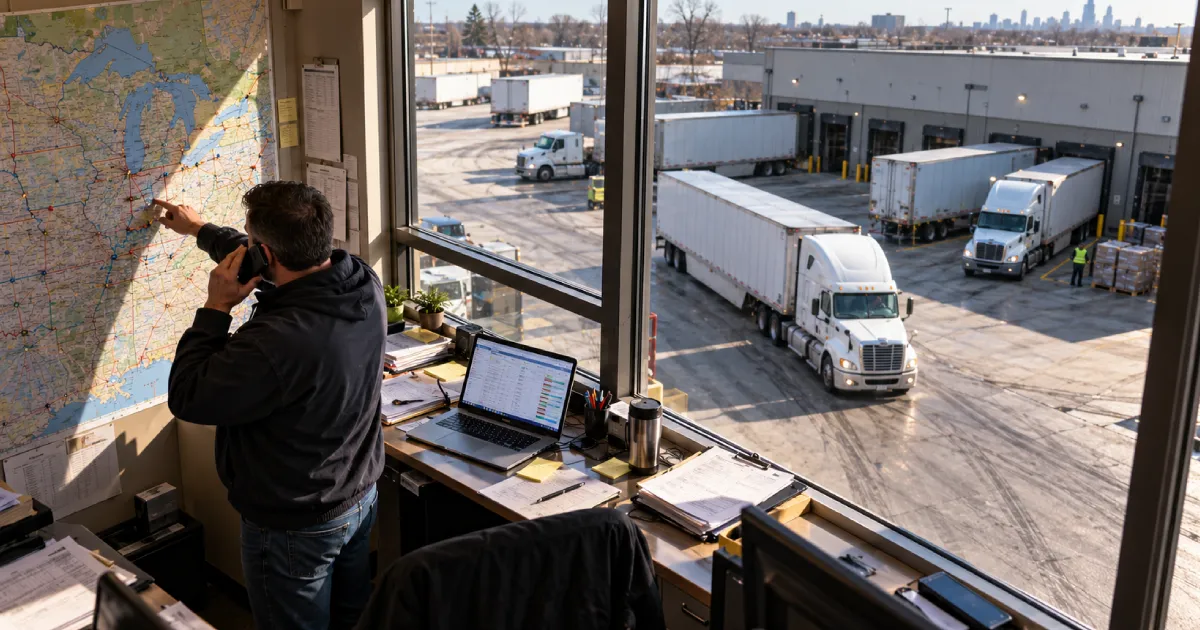
The dispatcher finds a dry van load on DAT or Truckstop, where brokers and shippers post available freight. The load pays $1,200, with pickup scheduled nearby on Tuesday.
During the call, the dispatcher learns that pickup is scheduled for 2 p.m. Tuesday.
The Chicago driver is still unloading. The dispatcher asks whether the warehouse will accept a later arrival and waits for confirmation before offering the truck. Accepting the load before receiving confirmation could leave the driver heading to a facility that hasn’t agreed to a later pickup.
Load-board filters help narrow the search by trailer type, pickup area, and date. They don’t supply every detail. Finding suitable freight means checking whether a dry van load requires the driver to unload, make an extra stop, or meet an early-morning delivery appointment. Each of these details could affect whether the load is worth accepting.
There’s no benefit in spending half an hour planning a route for a load that’s no longer available. Confirm that the load is still available before reviewing its requirements.
For example, unloading cartons by hand takes additional time at the delivery location. If the driver agrees to do it, the dispatcher confirms the payment and records the agreement. Without that agreement, a dispute over unloading responsibilities or payment could arise at delivery.
Freight matching apps suggest loads based on the truck information entered into the system. Saved searches and alerts bring new listings to the dispatcher’s attention. If the current delivery runs late, the dispatcher updates the truck’s availability instead of continuing to pursue loads with afternoon pickup appointments.
When contacting a familiar broker, a dispatcher can immediately discuss the available truck, its location, and the carrier’s preferred routes. After working together on several shipments, the dispatcher also learns how the broker handles problems. A missing pickup number is easier to resolve when the dispatcher can contact the broker who arranged the shipment.
Brokers arrange transportation for their customers. Working directly with shippers means arranging freight with the company shipping the goods, typically through its shipping manager or transportation team.
| Consideration | Broker-Sourced Loads | Direct Shipper Loads |
|---|---|---|
| Access to freight | One broker handles shipments from multiple customers | Loads come directly from the shipper’s facilities |
| Building relationships | Discuss available trucks and upcoming capacity | Discuss shipping schedules, recurring routes, and overflow freight |
| Onboarding | Complete a carrier packet and provide insurance documentation | Complete vendor approval and meet the shipper’s insurance requirements |
| Payment terms | Review payment history and any quick-pay fees | Agree on invoice terms and required delivery documents |
With an unfamiliar broker, verify its identity and contact details before sending paperwork. Check payment history too.
A manufacturer with extra freight this week may only have one shipment available. Arranging weekly pickups involves discussing how many loads the carrier can expect and how far in advance the manufacturer confirms shipments. Spot loads are priced individually. For contract work, the parties agree on rates and service terms for a set period.
An independent dispatcher represents the carrier according to the terms of their agreement. Once a load is selected, the dispatcher compares the written rate confirmation with the terms discussed by phone, including payment responsibilities and the documents required for invoicing.
Two loads offer similar rates, but finding the most profitable loads requires looking beyond the advertised price. One takes the Chicago-based owner-operator to an area where outbound freight is regularly available on Thursday mornings. The other ends late Friday in a town with little dry van freight leaving over the weekend.
The second offer could leave the driver waiting until Monday or driving empty to another city.
Before choosing, the dispatcher looks at what happens after delivery. Freight market analytics show activity around each destination, including how demand changes throughout the week. A regional average can be misleading if most of the recorded shipments originate from facilities 150 miles away.
Those additional 150 miles affect the trip’s profitability.
In trucking, driving without a paying load is known as deadheading. Reducing deadhead miles starts with estimating how far the truck will travel between paying loads, including the distance required to leave an area with limited freight.
The owner-operator and dispatcher have already agreed that the driver will be home by Saturday. Finding backhaul loads (freight carried on the return trip) means looking for shipments with delivery destinations along the driver’s route home. A detour adds fuel expense and could push the home arrival into Sunday.
The driver may have to take a required rest break before heading home. Hours of Service rules set limits on driving and working time, along with required rest periods. Canada and the United States use different rules. The dispatcher checks the driver’s remaining available hours and accounts for required rest periods when estimating when the driver will arrive home.
A busy destination still offers no certainty of return work. If the outbound load is profitable only with a well-paying backhaul, the owner-operator is relying on revenue that hasn’t been secured.
A hypothetical shipment pays $1,200 and covers 500 loaded miles. Reaching its origin takes another 100 miles of empty driving.
| Calculation | Result |
|---|---|
| $1,200 ÷ 500 loaded miles | $2.40 per loaded mile |
| $1,200 ÷ 600 total miles | $2.00 per total mile |
| 600 miles × $1.80 assumed operating cost | $1,080 |
| $1,200 revenue − $1,080 estimated operating costs | $120 remaining before additional expenses |
Revenue per mile shows how much the carrier earns for each mile driven. Compare it with operating costs calculated over the same distance, including empty travel.
The $120 remaining is not automatically net profit. Check what the $1.80 includes. If it covers only fuel and maintenance, insurance, equipment ownership, and the owner’s compensation still have to be deducted.
Fixed expenses become harder to cover when the truck travels fewer revenue-generating miles. The monthly insurance bill stays the same even when fewer trips bring in revenue.
Suppose a $60 toll bill falls outside the modeled costs. The remaining $120 drops to $60. The dispatcher can use that additional expense to support a request for a higher freight rate.
Market comparisons require similar care. Freight market analytics might report an average that includes fuel surcharges. Comparing that figure with an offer excluding fuel would overstate the difference.
When comparing spot and contract freight rates, the dispatcher considers fuel adjustments and the period covered by each rate. A price covering several months exposes the carrier to cost changes beyond today’s trip. The calculation must also account for projected fuel prices and expected mileage over that period.

The driver has completed the delivery. One dispatcher received the driver’s text update, another received the signed delivery paperwork, and the evening shift still doesn’t know whether the truck has arrived.
When evaluating truck dispatch software, use a realistic delivery scenario to test how employees access records, correct mistakes, and share updates.
Open that load in the system. The next dispatcher on duty needs the latest update and the delivery document in the same record, without searching a colleague’s inbox. When evaluating truck dispatch software, let an employee who hasn’t seen the demonstration try to find both.
Next, test how the software handles errors.
Attach a document to the wrong load and correct the mistake. Check whether another employee can still open the old copy. After the correction, both employees should see the updated document.
Connecting freight load matching apps to a dispatch system brings another test. Transfer the load details and compare the original information with the new record, field by field. Record any information employees have to enter manually again. Account for that additional work when estimating the staff time associated with the software subscription.
Notifications also require someone to take ownership of each task. With load board alerts and automation, check whether an employee can claim a task and whether colleagues see that change. When two employees respond to the same message, it becomes unclear who’s handling the request.
Bring the invoicing employee into the trial. Give them a completed shipment record to review independently, including retrieving its attachments. They’ll discover missing fields and awkward searches that don’t come up during a sales presentation.
A software demonstration moves at the presenter’s pace. During hands-on training, participants enter information into the software themselves. They work through unfamiliar fields, ask questions, and complete tasks with guidance from an instructor.
Our Truck Dispatcher and Freight Broker Specialist Training includes access to logistics software and practical exercises involving transportation documents. We teach dispatching and freight brokerage through live sessions, providing instructor feedback as participants complete their exercises.
Instructors explain industry terminology as it comes up during exercises and help participants understand the information they’re entering.
We maintain small class sizes to provide individual guidance. Our course also covers the basics of setting up a business for participants interested in starting a logistics company, along with customs documentation and cross-border transportation processes.
We offer live online and in-person classes, along with post-training support and mentorship.
Contact MAZE Consultancy & Training to explore our Truck Dispatcher and Freight Broker Specialist Training. Whether you’re preparing for a dispatching career or planning to start a logistics business, we’ll help you understand the available training and support.

Review completed loads and compare the actual results with the estimates used when booking them. Keep track of mileage, expenses, delays, and payment issues. Over time, you may find that certain customers regularly keep drivers waiting or that some routes involve more empty miles than expected. One delayed delivery doesn’t tell you much on its own, so look for patterns across similar trips. Use what you find to adjust your rates and decide which loads are worth taking again.
During a trial, track available loads on the routes the carrier regularly serves. Note how many remain available when contacted and how many lead to completed bookings. Include the time spent contacting brokers about loads that are no longer available. Test customer support with a specific question about a shipment change or payment issue. Before subscribing, check which features the quoted plan includes and how cancellation works. The trial should help determine whether the platform provides enough value to justify its cost and regular use.
List the vehicle’s interior dimensions, door opening, and payload capacity before contacting anyone about a shipment. For a box truck, loading access can rule out work that otherwise appears suitable. A delivery to a location without a dock could require a liftgate, and its capacity must accommodate the items being lowered. Confirm pallet-jack availability and any inside-delivery expectations as well. Providing accurate equipment details reduces unnecessary calls and prevents surprises when the driver arrives.
When evaluating dispatch companies, start by reviewing their fees and whether they can book loads without the owner-operator’s approval. For a percentage-based fee, establish whether fuel surcharges and extra payments are included in the amount charged. Ask who handles calls after hours and who provides coverage when the dispatcher is unavailable. The agreement should also explain how either party ends the arrangement. Clarify who controls the business accounts and who has access to shipment records from the beginning, including what happens to that access when the agreement ends.
Ask the shipper how it onboards new carriers and when it plans to review its list of approved carriers. Some companies invite bids, while others consider new carriers as needs arise. Find out what documents and references the shipper requires, which service areas it needs covered, and how it evaluates carrier performance. It’s also worth asking whether they’ll offer a trial load. This information helps the carrier prepare the required documentation and identify the appropriate contact when the shipper begins accepting new carriers.