


Summary
What is PIP, and can your carrier, warehouse, or importing business qualify? Partners in Protection is Canada’s voluntary supply chain security program, administered by the Canada Border Services Agency. Membership involves meeting eligibility criteria and security requirements for freight, facilities, employees, and outside providers.
Assessing whether to apply means weighing potential border benefits against preparation costs and ongoing responsibilities. Understanding the security profile, site validation, and revalidation requirements helps businesses evaluate their readiness. Companies considering U.S. CTPAT membership also need to understand how mutual recognition works and why separate applications are required.
Key Takeaways
Partners in Protection (PIP) is a voluntary supply chain security program administered by the Canada Border Services Agency (CBSA). It establishes a partnership between businesses and the agency to help prevent smuggling and other criminal activity involving commercial shipments.
Membership involves a review of how the business protects its shipments during transportation and storage, even when contracted carriers or warehouses handle the freight.
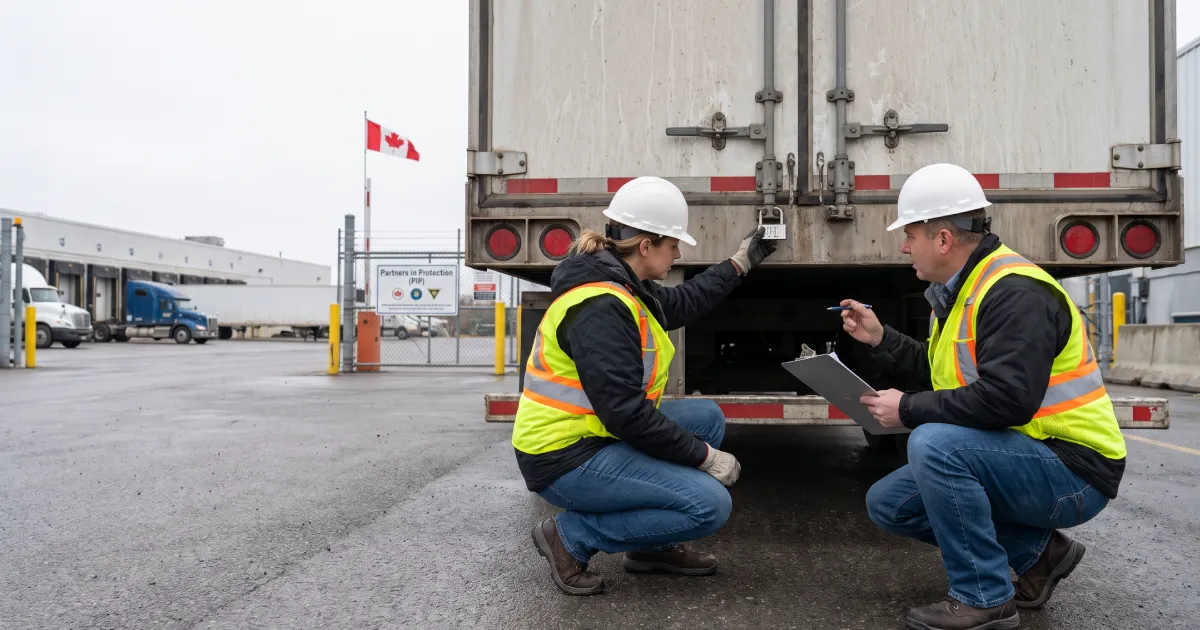
Companies join the program partly to reduce interruptions when moving goods across the border. The benefits listed by CBSA include lower examination rates, trusted-trader recognition, and access to Free and Secure Trade (FAST) lanes for qualifying shipments.
To use FAST lanes, both the shipment and the driver must meet the applicable eligibility requirements. Inspections can still delay the truck, so dispatchers should leave room for border delays when booking delivery appointments.
In the United States, Customs Trade Partnership Against Terrorism (CTPAT) serves a similar purpose. The mutual recognition arrangement between PIP and CTPAT allows approved members to receive certain benefits in both countries. The authorities have agreed that their standards and assessment methods are compatible. Companies seeking membership in both programs must apply separately to each authority.
In Canada, the program is open to commercial carriers across all transportation modes, importers and exporters, warehouse operators, freight forwarders, and customs brokers. Couriers enroll as carriers.
For U.S. businesses, eligibility is limited to:
Applicants must own or operate facilities that are located in Canada or the United States and are involved in international commercial shipments.
Applicants should review the operating history requirements early. They need 12 months of cross-border activity, including at least one shipment moved or arranged within the 90 days before applying.
A carrier that has been operating for only three months has not yet met that threshold. An established importer can review its recent shipment records to confirm whether it meets the activity requirement.
Applicants must also be solvent, have no unresolved debts to the Crown, and not be in undischarged bankruptcy. Certain convictions and significant regulatory violations can make an applicant ineligible.
The program’s minimum requirements cover employees, facilities, transportation equipment, and shipment data. They also address work performed by outside providers.
Employee training covers recognizing and reporting suspicious activity during daily work. For warehouse staff, this includes recognizing and reporting unauthorized access to loading areas. Drivers learn to identify signs of interference with their equipment and report them to the appropriate person.
A written risk assessment identifies the threats facing the business and explains how management addresses them.
Cybersecurity measures protect access to dispatch systems containing pickup instructions and delivery addresses. An account left active after an employee’s departure could allow someone to change those details and divert a load. Physical access controls restrict entry to premises and cargo areas.
Bolt and cable seals are among the devices used to secure freight containers and trailers. Their condition and identification numbers help staff detect possible tampering. Staff must investigate any seal number that doesn’t match the shipping record, even when the seal appears intact.
CBSA reviews equipment inspections and the company’s procedures for handling suspected tampering. Cargo records also help establish whether the goods received match the accompanying documentation.
Security measures also address contamination. Soil and pests can travel with shipments on equipment or wood packaging, so the assessment covers cleanliness and equipment condition.
Once a subcontracted carrier collects freight from a secure warehouse, it controls the vehicle during transportation and is responsible for protecting the load while it is in its custody.
The company must explain how it selects and monitors that carrier. For contracted storage, the company must explain the warehouse operator’s security controls and who has access to the goods.
These responsibilities are recorded in the PIP security profile. The profile needs to identify which safeguards depend on outside providers, including providers working at locations the company doesn’t manage.

CBSA reviews the submitted profile and conducts a risk assessment before arranging site validation where required. Preparing the submission involves confirming the procedures used at each terminal, particularly when the business operates several locations.
Warehouse managers are the right people to confirm where loaded trailers actually wait overnight. If one terminal uses an open overflow lot, a company-wide statement that all trailers remain inside fenced premises would misrepresent that location.
The profile needs to describe the overflow lot and how the trailers are protected there.
After an acquisition, staff at the acquired location may still follow the previous owner’s procedures. The profile must describe the procedures currently followed at that site.
Site validation gives an officer an opportunity to examine the controls described in the submission. At shared premises, this includes establishing which access controls the company manages and which the building operator manages.
CBSA uses the assessment findings to decide whether to approve membership.
CBSA requires members to update their company and security profiles immediately when information changes. Members also report relevant threats and respond to requests from the agency. The PIP minimum security requirements remain in force after approval.
When dispatch starts using a different carrier, the company reviews how that provider protects freight during transport. Moving goods to another warehouse requires a review of access to the building and the areas used for loading or storage.
If the employee responsible for the company’s participation in the program leaves, their replacement needs access to the program correspondence and application records. An outstanding agency request may have a response deadline, and the person taking over has to establish what was sent and what remains unanswered.
Revalidation follows the fourth anniversary of membership and involves a profile review and renewed site validation. CBSA reserves the right to conduct compliance reviews between revalidations. Failure to meet the program’s conditions puts membership at risk of suspension or cancellation.
CBSA charges no fee to join the PIP program.
The preparation budget covers employee time, documentation work, and any facility improvements. Consulting is optional.
For a business with three terminals, several managers may need to spend time preparing the application while also handling their regular duties. Reviewing existing records helps identify what still needs to be done. Staff time spent gathering information from contractors also adds to the cost, even when the business handles the application internally. Repairs or changes to access controls add direct expenses.
Maintaining membership takes staff time after approval. Budget for updates and preparation for revalidation.
Before joining the program, an occasional cross-border shipper should confirm whether customers require or prefer PIP-approved providers and which shipments would qualify for benefits. A carrier that regularly crosses the border can assess whether the benefits justify the costs based on its routes and delivery commitments.
At MAZE Consultancy & Training, we help companies assess their readiness for PIP membership and work through the requirements that apply to their operations. That includes organizing the information needed for an application and clarifying who controls freight when several businesses handle it.
We also help companies prepare for validation and offer external audits to review procedures and identify gaps.
CBSA decides whether to approve membership.
Contact MAZE Consultancy & Training with a brief description of where your freight is handled and whether you’re preparing your first application or approaching revalidation.

Yes, with the company’s authorization. The business remains responsible for information submitted by its consultant. If a description of trailer storage is inaccurate, management still has to explain and correct it. Employees familiar with the operation can review the documents for accuracy before submission. The consultant organizes the information and works with the team to clarify any descriptions that are incomplete or unclear.
Compare similar trips before and after approval, accounting for changes in traffic, shipment volume, and the border crossings used. Track examination frequency and time spent awaiting clearance over several months. Track opportunities to work with new customers that require PIP membership for inclusion on their approved carrier lists. If dispatch procedures or delivery schedules changed during the same period, account for those changes separately when assessing the results.
Yes. PIP eligibility requirements do not set a minimum number of trucks. A small fleet is assessed against the applicable security standards, just as a larger carrier is. An owner who personally approves every pickup can explain that process and what happens when someone else takes over that responsibility. The assessment concerns whether the company’s safeguards work consistently across its operations, including during absences or changes in staffing.
Participating customs authorities exchange program-related information with the member’s consent to recognize approved businesses and provide the associated benefits. Members authorize this exchange through the Certification and Authorization to Disclose Information form and can change or withdraw their consent. When a company expands into another market, access to recognition benefits depends on whether it has authorized information sharing with that country’s participating customs authority.
Yes. A business operating from leased premises is eligible to apply if it meets the other eligibility requirements. Building ownership is not required. At a shared terminal, responsibilities often extend beyond the tenant’s loading area. If the landlord manages the entrance and visitor access, those controls also affect the company’s freight. The application must explain who is responsible for each security measure and how the safeguards at the rented location meet PIP requirements.